

How To Set Up Yamaha Hs7
How exercise you set up studio monitors? What should I exist looking for in the best home studio monitors? And why should I be tracking with studio monitors in the starting time identify?
These are very common questions for first-time domicile studio users, and Yamaha and Performer Magazine have teamed up to aid guide you towards setting upwards and choosing the best studio monitors for your home recording needs.
Welcome to the fourth and terminal installment in our series aimed at providing real-earth advice for setting up your starting time domicile recording studio. In this article, nosotros'll take a closer look at studio monitor speakers, specifically what to await for in domicile studio monitors and how to set up studio monitor speakers in your space for optimal results. Yamaha has been kind enough to lend us a pair of their legendary HS8 powered studio monitor speakers, which we've gear up up in our function studio and will exist using as examples throughout the entire series of articles.
▼ Article continues below ▼
How-do-you-do-FI SPEAKERS VS. STUDIO MONITOR SPEAKERS
What skillful is mixing a vocal if you're not hearing it properly? Unlike consumer hi-fi speakers, which oft colour the audio to make for a more pleasant listening experience, Studio Monitors typically offer a Flat frequency response, which ensures that your mix will sound great on most whatsoever system. For years, the go-to for dwelling recording studios and commercial studios alike have been Yamahas. Yous've probably seen the classic white speaker drivers in endless photos and videos. Nosotros've been testing out the HS8 viii" powered studio monitors, and the legendary sound Yamaha is known for comes through loud and clear during both tracking and mixing. Our recommendation is not to skimp in this area – hearing your mix through pro-level monitors will be crucial when it comes to crafting the right sound for your projection. The HS8'due south offer boosted controls for high trim and for compensating for your room environment. These features tin can make the departure when it comes to producing your project the correct way.
▼ Article continues below ▼
SIZE MATTERS
Abode studio spaces can be a tight squeeze and nosotros know budgets can be fifty-fifty tighter; still, we don't typically recommend speakers with woofers under 5" for all-time results. At present while there are some surprisingly decent studio monitors equipped with three" main woofers, the beginning thing you lot're going to sacrifice with smaller speakers is frequency range and whatever sense of deep bass. And if you're not hearing as much of the spectrum as possible, yous're missing out on nuances in your recordings that could come back to seize with teeth you when it comes time to mix or master your work.
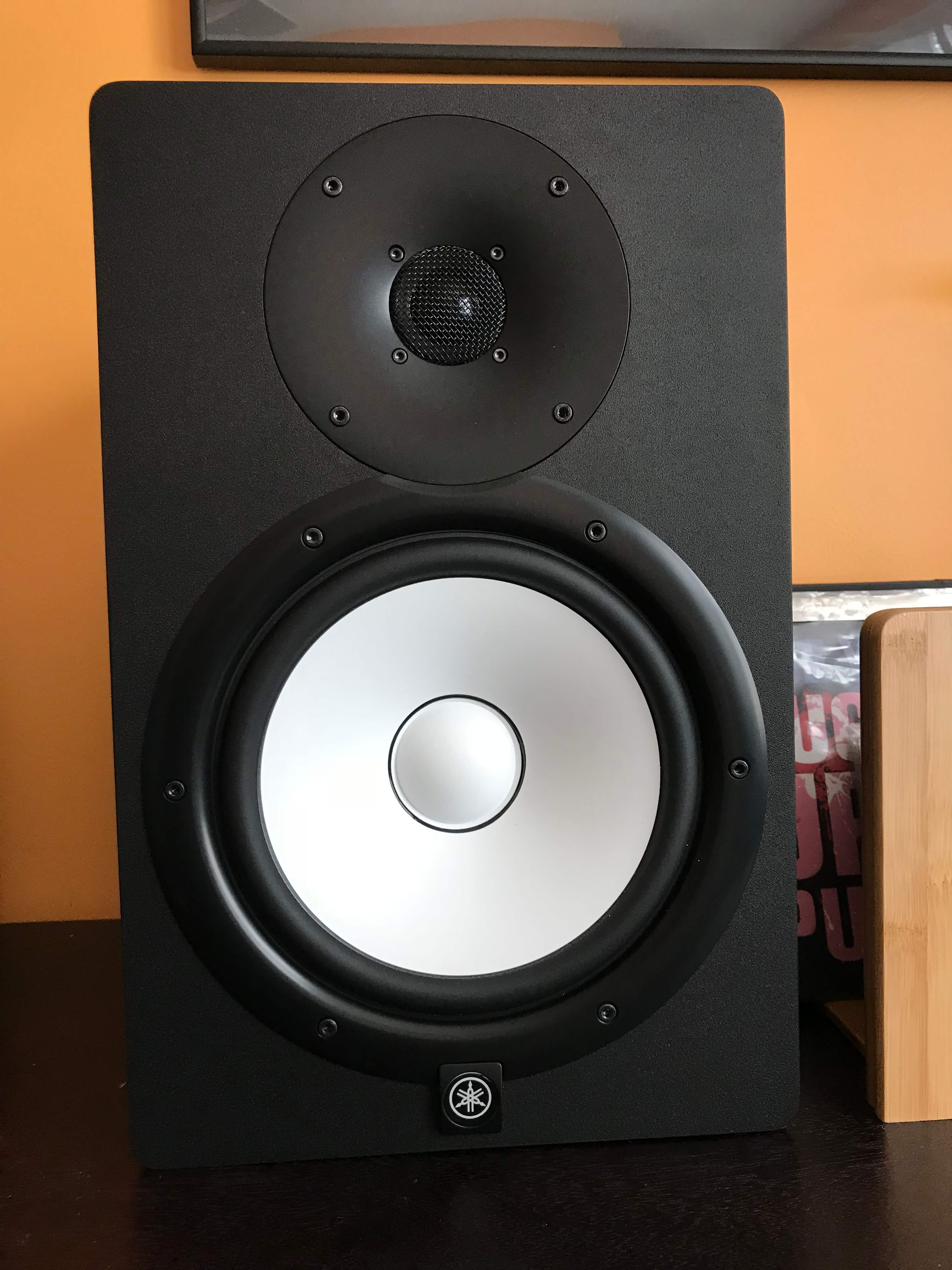
At present, most mere mortals can't technically hear above 20kHz, just many powered studio monitors are "extended range," meaning they are capable of reaching 30kHz or even higher. Why does this thing? Because even though you might not exist able to "hear" extreme sounds (the same goes for ultra-low bass frequencies), believe it or not your brain might be able to actually "feel" some of those waves. And there take been studies on the emotional response to music with frequencies above and beneath our "normal hearing range" cut out and/or added in. Nosotros don't accept time to dissect psychoacoustics here; the key takeaway is the larger the speaker cone, the wider the response. So, an 8-inch woofer, like those packed into our HS8 monitors, volition be able to reproduce deeper bass (down to 38Hz) than a smaller v-inch model in the range (the HS5, which tin can reproduce sound accurately simply down to 54Hz).
Your upkeep might dictate, to an extent, the size of the studio monitors y'all choose, merely if you program on tracking/mixing deep electronic bass or even gut-punching metal, try to go for the biggest models that fit your wallet and studio space.
If you absolute cannot afford, nor have the desk space for, larger studio monitors, you lot may wish to add a subwoofer down the line to help handle some of the lower frequencies based upon your cutoff point.
PASSIVE VS. Active
Every bit with PA speakers, you're typically not going to be running into many passive home studio monitors, meaning speakers that do not crave power to operate. Powered speakers are much more common in the home studio realm, and typically will non only come with their ain clean ability amplifier built into the system, only likewise some additional controls that passive speakers but cannot or do non offer. But be aware that you'll need an available ability outlet in your studio rig to adapt studio monitors.

Yamaha HS8 monitor speakers rear
Primal SPECS AND FEATURES
Aside from woofer and tweeter size and frequency response, there are a number of key features to the HS Series speakers that make all the difference in quality, and are some things you lot should go along an eye out for when y'all're running downwards the spec sheet. For starters, powered monitors demand a high-quality amp to drive the speakers cleanly (you don't want clipped, distorted sound, do you?), and the HS8's come equipped with a bi-amp design with dissever defended amps for both the woofer and the tweeter. One of the benefits to a loftier-quality amp is that it will evangelize consistently flat responses beyond the spectrum. Be wary of monitors that don't disclose their amplifier types or specs.

HS Serial High Operation Amp Unit of measurement
Next, have intendance when choosing speaker enclosures (the actual material the "boxes" are constructed from). The HS Serial is built using a dumbo and resilient MDF textile, which is perfect for reference-quality playback due to its inherent ability to dampen audio-visual response. Bottom line, the enclosure tin exist responsible for eliminating (or at least helping to reduce) acoustic issues, rattling, and trouble-child resonances that lower-quality monitors may suffer from.
So far, nosotros've taken a look at the box, the amp and the actual speakers, simply what about the connectivity? Powered studio monitor speakers aren't going to have standard speaker wire terminals like your stereo; rather, they will likely accommodate counterbalanced XLR or 1/4" inputs. It's crucial to lucifer the inputs on the studio monitors you're selecting with the outputs available on your sound interface. If the monitors you lot're looking at don't accept XLR inputs, but for some reason that's the merely available output blazon on your interface or console, it's time to make some other option. Thankfully, the HS8 monitors we've been running offer both XLR and i/4″ inputs for flexibility.

Depression Resonance Enclosure Design
And lastly, look for extra sound-shaping capabilities and other adjustments that will assist tailor your monitors to your specific audio-visual space. For instance, the HS8's offer room command capabilities every bit well as additional high-trim features to assistance tame frequencies in your room. Yous desire the about accurate reproduction possible, so these high-end features tin make all the difference in a home production.
HOW TO POSITION STUDIO MONITOR SPEAKERS
We'll defer to Jay Frigoletto, expert mastering engineer with Mastersuite, who's written on the subject in-depth forPerformer:
"A mutual technique is to arrange monitoring on an equilateral triangle with one betoken being the listening position and the other 2 points being speakers aimed at the listener at 60º angles. Symmetry is important. You don't want to be twice every bit far from the left wall as the correct, or rotated with 1 speaker further from the front end wall than the other. Try to go along some space between speakers and walls. Direct audio, following a straight path from speaker to ear, mixes in undesirable ways with reflections from nearby surfaces such every bit walls, tables, and mixing consoles.

The reflected path, from speaker to wall to ear, is longer than the direct path, resulting in a copy of the sound arriving just after the original. Sound is comprised of alternating higher and lower pressure level, or in electronic transmission, positive and negative voltage. When a delayed point combines with the original, one may exist cycling positive, and the other, negative. These energies work against each other, reducing level at sure frequencies (subversive interference). Both signals being in a positive wheel results in reinforcement at some frequencies (constructive interference). Neither example is welcome considering information technology changes the frequency response of the audio from your speakers.
The easiest way to determine placement of treatments to blot early reflections is to grab a mirror and enlist the help of a friend. While yous sit at the listening position, your friend places the mirror flat on the wall, moving it until y'all tin can see a speaker. Center your treatments at that place. Sound and light travel in waves and reflect in similar means (angle of incidence equals bending of reflection), so the mirror shows the first reflection paths from your speakers to your listening position. Ceilings, floors, and consoles too tin be a source of unwanted reflections."**
A QUICK Discussion ON BASS TRAPS
Once again, nosotros'll let Frigoletto accost proper setup in your dwelling house studio:
"Depression-frequency assimilation, or bass trapping, is essential in pocket-size rooms, and acoustically speaking, any room in a firm is a modest room. Standing waves are a particular case of constructive and subversive interference between parallel walls causing certain frequencies to either ring or all but disappear at specific locations (anti-nodes and nodes). Ane node will exist exactly half-way between the front and back walls, so it's best to have your listening position in front or behind the half-manner signal.
The poor bass response in un-trapped rooms contributes to many dwelling studio mixes having problems in the depression terminate. If you are missing bass at your listening position, you lot're probably in a node. It may seem counter-intuitive to trap bass when y'all don't accept enough, simply that's exactly what to do. The missing bass is caused by sound bouncing betwixt ii walls, with the low pressure level in one management combining with the high force per unit area in the other, thereby cancelling each other out. If you lot trap the bass, it won't bounce back, eliminating the cancellation and restoring an even bass response.
The simplest bass trapping is a thick porous cushion in the corners or on the back wall, often called a "super-chunk." The archetype material for these and many other absorptive treatments is Owens Corning 703 semi-rigid fiberglass boards in a frame covered with Guilford FR-701 material. The thicker the panel, the better the low-frequency absorption. Leaving a small space between panel and wall as well improves low frequency operation. Four-inch panel depth gets you into the lower mid-range, but for real bass trapping, you'll need it to exist several times thicker."
Closing THOUGHTS
We hope this installment has helped guide yous on your style to setting up studio monitors for optimal recording and mixing in your home studio. Keep in mind that this series is aimed primarily at the beginner dwelling studio user in an effort to dispel common myths nigh abode recording, and to make the entire process much less intimidating than information technology might seem at first.
Caput to https://usa.yamaha.com/products/proaudio/alphabetize.html to learn more and to discover the products that will fit YOUR home studio needs.
And don't miss the first 3 entries in the series (links below). Over again, be sure to check out the entire range of Yamaha professional sound products hither and follow Yamaha Music USA on Facebook and Twitter.
Don't Miss Our Previous Articles in This Series:
Part 1: "How to Ready the Ideal Home Recording Studio."
Role 2: "How to Choose the Best USB Audio Interface."
Part 3: "How to Mix With Studio Monitor Headphones"
**For more, be sure to check out iv Tips To Better Domicile Studio Acoustics.

How To Set Up Yamaha Hs7,
Source: https://performermag.com/home-recording/home-recording-yamaha/how-to-set-up-studio-monitors/
Posted by: dixonthounfor.blogspot.com
0 Response to "How To Set Up Yamaha Hs7"
Post a Comment